
Sunday, September 30, 2007

Rice, What's the Difference?

At the supermarket yesterday I noticed a packet of brown rice, I wondered if there was any truth to how much healthier it claimed to be, so I decided to do some research, this is what I discovered.
Brown rice, also known as "hulled rice", is not milled or only partly milled rice. It is chewier than white rice and has a slightly nutty flavor. It has more nutritional value than white rice but by comparison decomposes more quickly.
White rice is rice which has been milled, having it's husk, bran and germ removed. This is done to extend the life of the grain, so that it can be shipped further and stored for longer.

The Milling process
The main difference between brown rice and white rice is the milling process, which affects the nutritional content. Milling is often referred to as "whitening" because the variety of rice may be identical, but milling removes the husk and the bran from the grain turning it from brown to white. After milling, white rice is polished, to give it a bright, white, shiny appearance.
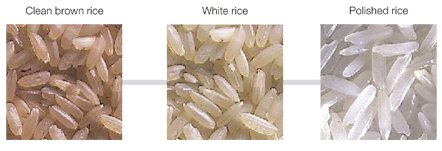
Take a Grain of rice --> remove the outer layer (the husk) = Brown rice (bran layer) --> remove bran layer = White rice.
So what's lost in the milling process?
The process of removing the husk and the bran from the rice takes away some of the nutritional benefits of rice. For more information on the nutritional information please see the table below.
  • During the milling and polishing process many vitamins and dietary minerals are lost. In "enriched" white rice some of these nutrients are added back in a chemical form, such as vitamins B1, B3, and iron, but the majority are lost.
  • In removing the bran layer the oil is also removed, a recent study has shown that rice bran oil may help lower LDL cholesterol.
  • Fiber and fatty acids are also lost in the process, one cup of brown rice has over three grams of fiber, while the equivalent white rice has less than one gram.
  • Brown rice is reputedly easier to digest, because it contains more bran than it's white rice counterpart.
There is also a chemical difference between the two for more information please compare: White rice and Brown rice.

Table of Nutritional differences between Brown and White rice:

Brown Rice (one cup) White Rice (one cup)
Calories 232 223
Protein 4.88 g 4.10 g
Carbohydrate 49.7 g 49.6 g
Fat 1.17 g 0.205 g
Dietary Fiber 3.32 g 0.74 g
Thiamin (B1) 0.176 g 0.223 g
Riboflavin (B2) 0.039 mg 0.021 mg
Niacin (B3) 2.730 mg 2.050 mg
Vitamin B6 0.294 mg 0.103 mg
Folacin 10 mcg 4.1 mcg
Vitamin E 1.4 mg 0.462 mg
Magnesium 72.2 mg 22.6 mg
Phosphorus 142 mg 57.4 mg
Potassium 137 mg 57.4 mg
Selenium 26 mg 19 mg
Zinc 1.05 mg 0.841 mg

Cooking Brown Rice
Brown rice takes longer than white rice to cook, so you need to increase the amount of water slightly.
  • To prepare brown rice, use 2 cups of water for each cup of brown rice, and salt to taste.
  • Bring salted water to a boil, and stir in rice.
  • Reduce heat to a minimal simmer, and cook tightly covered for 30-45 minutes or until all water has been absorbed into rice.
Note: Use slightly more water for sticky rice. Use slightly less water for fluffy.
Adding a couple tablespoons of yogurt helps to give brown rice the texture of white rice.


Reference:

http://en.wikipedia.org/wiki/Brown_rice
http://en.wikipedia.org/wiki/White_rice
http://www.drlam.com/opinion/brown_rice_vs_white_rice.cfm
http://nutrition.about.com/od/healthyshopping/f/brown_white_ric.htm

Saturday, September 29, 2007

Cleaning out the Cobwebs

Today I've been moving the non computer related posts from GeekyBits³ to here at Of Tea and Turtles (TnT). My apologies for any inconvenience that my cleaning may cause. I need to keep that blog purely for computer and technology related subjects, so I moved the other posts here.

I tried to keep the dates and comments on the posts as best I could, although there where a few posts that didn't play fair, most are in the original format. I have gone though them looking for broken links and I think I managed to get them all, yet if anyone spots one I would really appreciate it if you could let me know,
Thank You!!!

Life is pretty simple

"Life is pretty simple:
You do some stuff. Most fails. Some works.
You do more of what works.
If it works big, others quickly copy it.
Then you do something else.
The trick is the doing something else."
Leonardo da Vinci

Animé is safe

The happenings over the past week have once again reinforced to me that Animé is safe.

In Japan animé refers to all animation, elsewhere it refers to a subset of animation originating in Japan. A lot of animé is based on manga. Manga is the Japanese word for comics and print cartoons.

What I mean by animé being safe is that the characters never let you down, they will never disappoint you or make human mistakes. It's safe to look up to the main protagonist in a comic book, or an animation. It's safe to treat these heroes as heroes.

Real life heroes turn out to be human. They make mistakes, they disappoint, they let you down.

For as long as I live Goku (The main protagonist in the DragonBall series) will never do something untoward. I will never question the way I think of him. I will never feel disappointment, nor sadness, nor fear from his actions. Humans frequently mess up, they are human after all.

It is safe for children to look up to cartoon heroes. They are less likely to be hurt or do hurtful things to others copying a cartoon hero. Yet real life heroes (especially bad ones) can really badly affect children, even later on in their lives.

Hero worship is a need that most humans seem to have. A need to believe in something greater than ourselves. A need to draw inspiration and faith from someone who's already achieved. A need to compare ourselves, and lives to others.
Yet at least if your hero is an animé hero it is much safer.

Sunday, September 23, 2007

Fresh Glass of Water?

The other day I recieved a graphic example of how well my water filter works. I've had many people ask me why I filter my water, and there are many good reasons to do it. If I could afford to I would filter all of the water that comes into my home!

I have a Brita water jug, and all of our drinking water, including water for our plants, and the kettle goes through the jug. At the Brita (Australia) website there is a really good explanation as to why you would want to filter your water? if you would like more information.

A few days ago the council was working on our water pipes, and they turned off the water for about seven hours, when it came back on, it was not pretty. Pictured right, is how it looked after the tap had been running for about 10 minutes. I didn't want to wash my hands under that, let alone drink it. It has since slightly improved, although still a little orange, (I'm shuddering right now!)

I thought this was a perfect time to test the water filter, I should note: the filter needed changing, so it was on it's last legs at this stage.
Pictured Right the water before and Pictured Left the water afterwards. I was so impressed, this really made me see why my partner said that it was so important to have a water filter.
I get to have a fresh glass of water without all those chemicals and crap woohoo!!!

You can clearly see in this picture below the water at the top, out of the tap, and the water below, after being through the filter. I honestly don't know what I would do without my filter, it is amazing!

Slice Anyone?

We have a new kitchen appliance in our home, and it's wonderful. It has taken me a little while to get used to the way that it works, however now I can have fresh bread, pizza dough, cake mix or anything else I can imagine to mix, or cook in a Bread Maker.

Making your own bread, without a bread maker, can be a bit of a trial, it takes a long time, and the things that can go wrong are numerous, but it does save you a lot of money.

Now that we have a bread machine I don't have to worry, we can make a loaf of bread for between $0.75 and $1.25, (Considering the average loaf of bread is around $3 AUD I'm not whining) and it's really easy to use. It took me a bit of experimentation to discover what was the right mix of ingredients for my machine (each one varies), but now that I've worked it out it's really simple.

I certainly think that it is worth the money, and I wouldn't take it back. Not only is it easy and fun to make but the smell of fresh bread is amazing. The other big bonus is that I know Exactly what's in my bread, no preservatives or nasties just what I put in. I love it, and the birds seem to appreciate the leftovers too ;)

Below is my first ever loaf of bread from our bread maker...

Monday, September 10, 2007

The Newest Member of Our Cacti Family

I've been incredibly spoiled today, my partner brought another Cacti to go with out little family of plants. This is him in the picture.

I love him, he is very fluffy, and deceptively dangerous. He is an "Old Man Cactus" called "Cousin It", I think I'll call him "IT"!

The fine hair is to protect "IT" from sunburn. The stronger the the sunlight the better the hair will grow.

If he develops like my other cactus, the hair will get longer when he is happy as well.

He needs water when he is dry and once a month in winter. He also needs a slow release plant food, or liquid feed over 2 months (except in winter).

Saturday, September 8, 2007

Everything is relative

I've been a little out of it lately, a lot has happened I guess. I felt the need to remind myself of how much human society matters in life's scheme, so I decided to look at the Powers of Ten website.

"Powers of Ten explores the relative size of things from the microscopic to the cosmic. The 1977 film travels from an aerial view of a man in a Chicago park to the outer limits of the universe directly above him and back down into the microscopic world contained in the man's hand. Powers of Ten illustrates the universe as an arena of both continuity and change, of everyday picnics and cosmic mystery. The film also demonstrates the Eameses' ability to make science both fascinating and accessible."
The following YouTube videos further explain the Powers of Ten:

This first video is a short film by Charles and Ray Eames for IBM: 'dealing with the relative size of things in the universe, and the effect of adding another zero'.

This video is a clip from the Imax film "Cosmic Voyage" with commentary by Morgan Freeman. It's not very good on the small screen, but you'll get the idea. Also it repeats, yet I didn't mind watching it twice ;)

And lastly the Simpson's opening sequence, a homage to IBM's Powers of Ten.

An Amazing Magic Trick

I'm a sucker for a talented magician, so I thought I would share another amazing magic trick with you, by Kevin James:

Aloes: flowering succulents

A couple of days ago my partner brought me a new plant to add to my collection (Pictured right). It is of the Aloe genus, which contains over 400 varieties.

I've just been doing some research on the genus and I've found some very interesting information.

All of the plants in the genus are flowering succulents, and are native to Africa. Most Aloes have rosettes of fleshy leaves.

The leaves are generally long and thick in the middle, tapering off to a point, with spiny edges and the color of the leaves varies from gray to bright green.

The flowers are frequently yellow, orange or red in color and tubular in shape.

Many Aloes have some amazing medical properties, and have been used in numerous ways over time. Aloes have been used in everything from drinks, and food to ointments, and hair styling gel. They are certainly a very amazing genus of plant.